Work that runsWork that runsWork that runsWork that runsitself.
You have a bottleneck that eats the same hours every week. I kill it with a production
pipeline — or I tell you not to bother.
Production n8n and custom automation pipelines with idempotency locks, dead-letter queues, and schema contracts. Automation Audit $500; builds from ~$2,500.
Live production graph
READY
Swipe the canvas →
Start with the $500 Automation Audit. Credit applies to any project — automation or agentic.
Real builds from production
Twelve that still run.
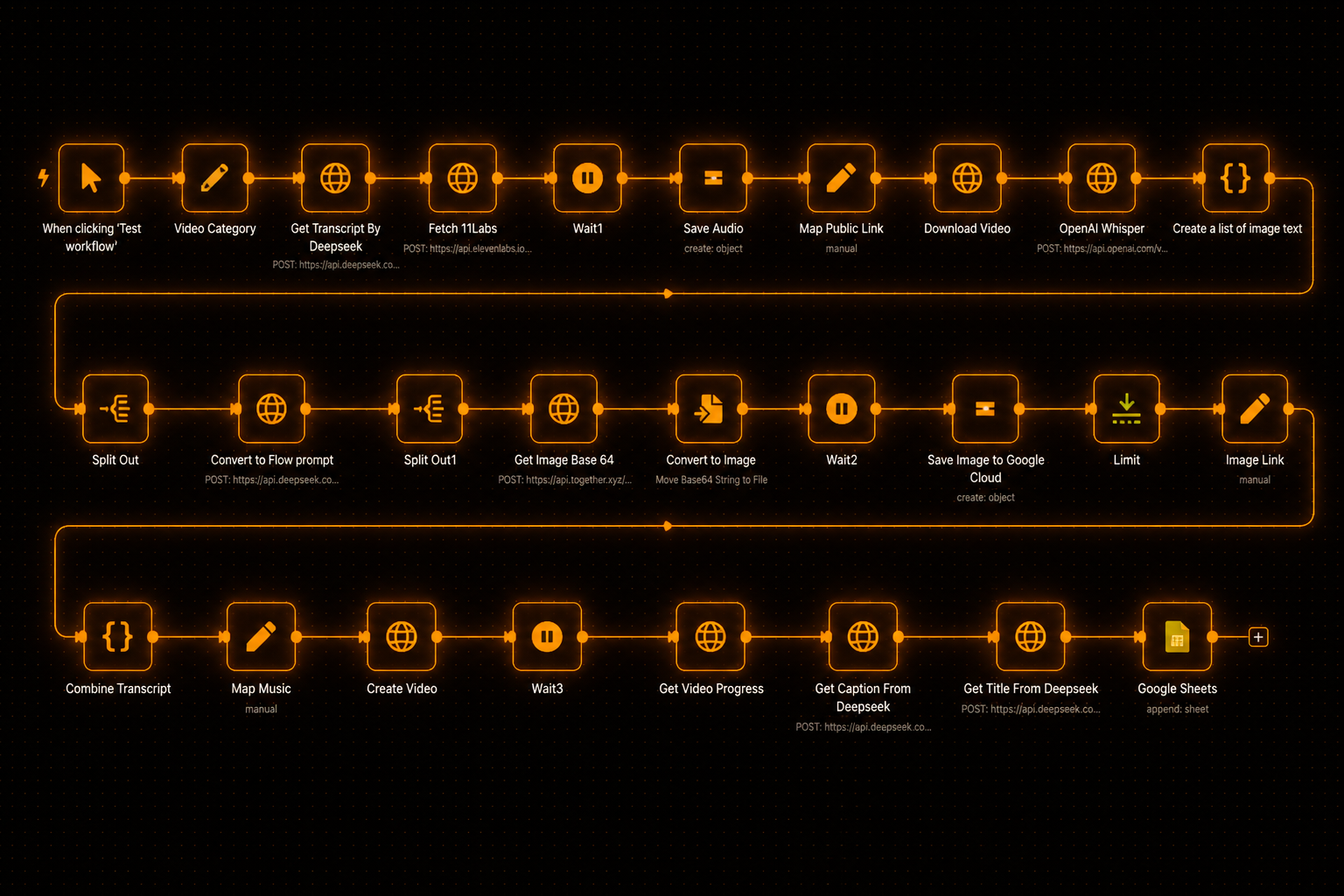
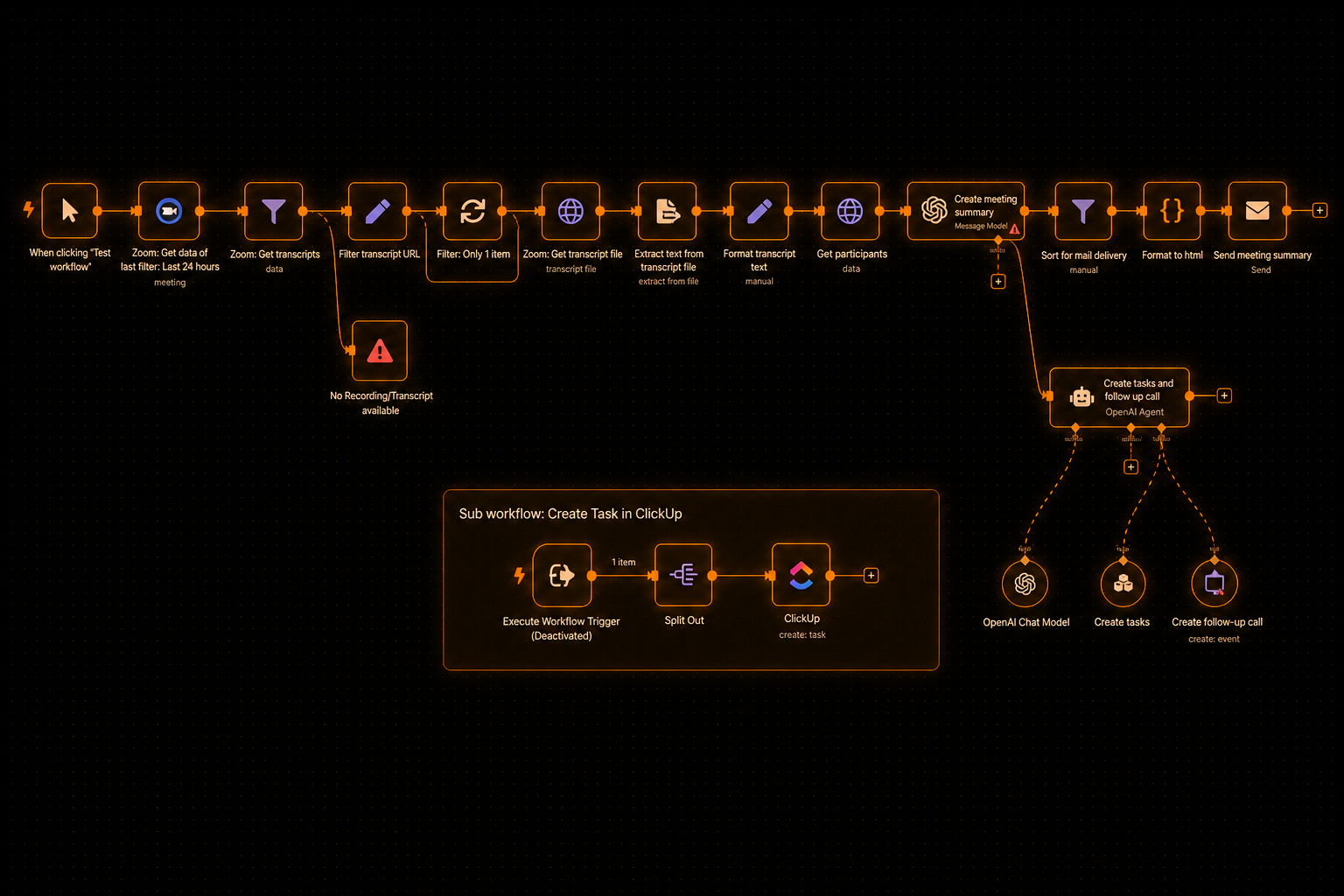
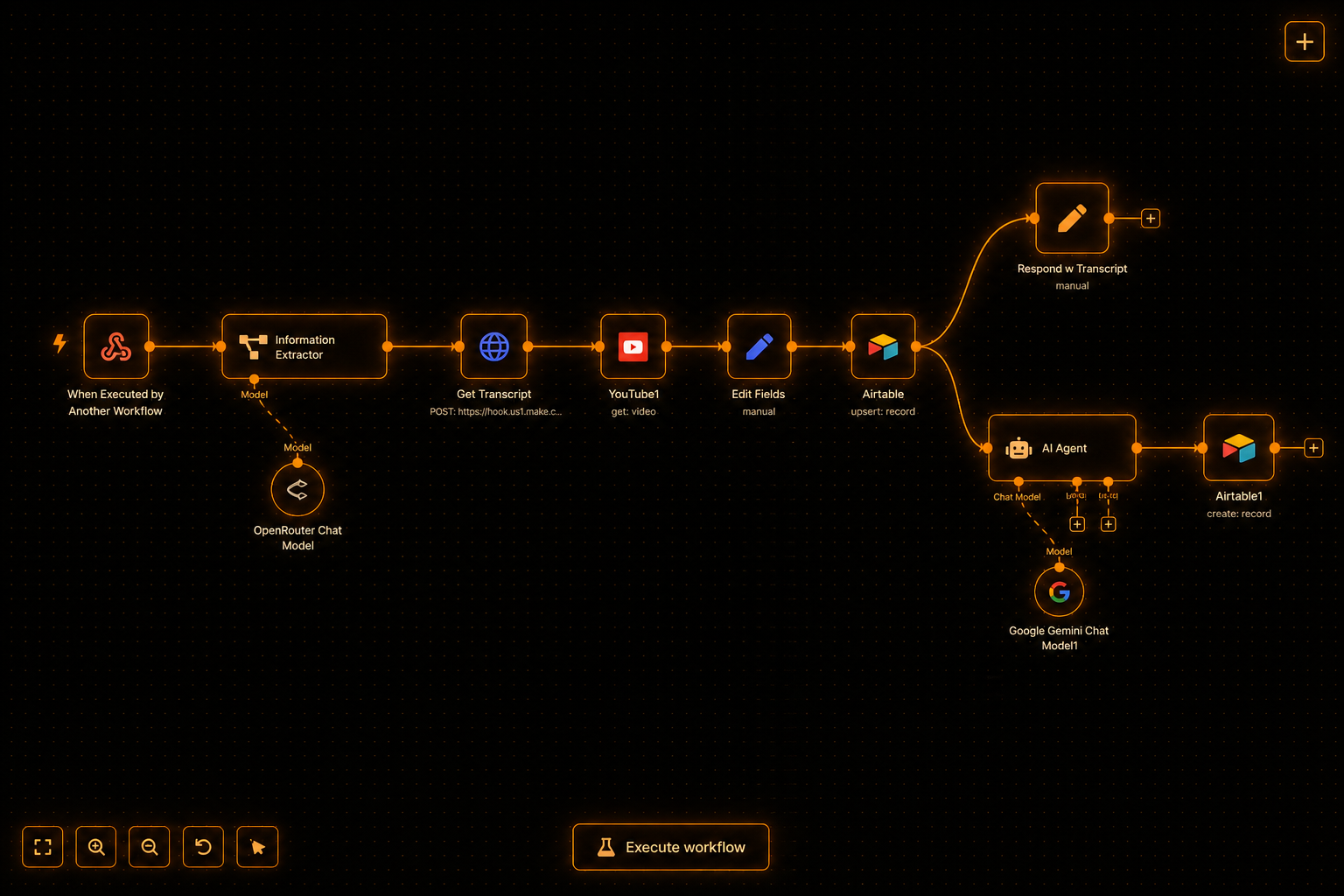
Real n8n canvases — node names, branches, tool hang-offs. Not mockups. If one looks like
your bottleneck, book the audit. If you want the shelf price, open the workflow library below.
Browse 12 buildsExpandCollapse
PublishedWebhook · meeting ended·
FirefliesGrok 4Gemini 2.5 ProGPT-5Notion
One webhook turns a finished sales call into four scored analyses — SPICED, GPCTP, Discovery and BEAUT-BED — before the rep has closed their laptop.
— Four frameworks, one call, zero note-taking.
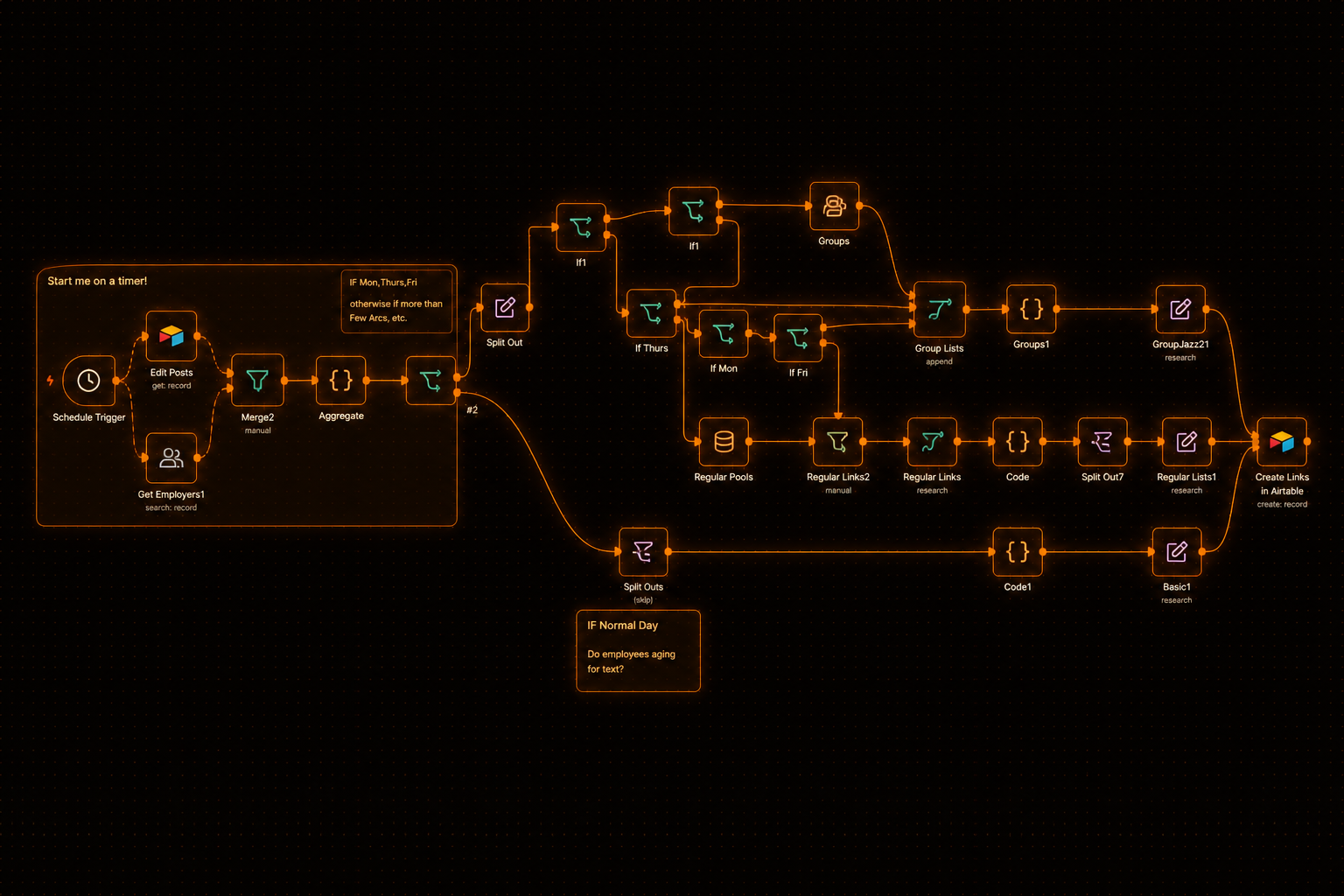
Ops · Airtable routes
Daily routes — assigned, not debated.
Timer pulls pools and techs from Airtable, branches Mon/Thu/Fri geo groups,
round-robins by pool type and skill, then writes Daily Lists.
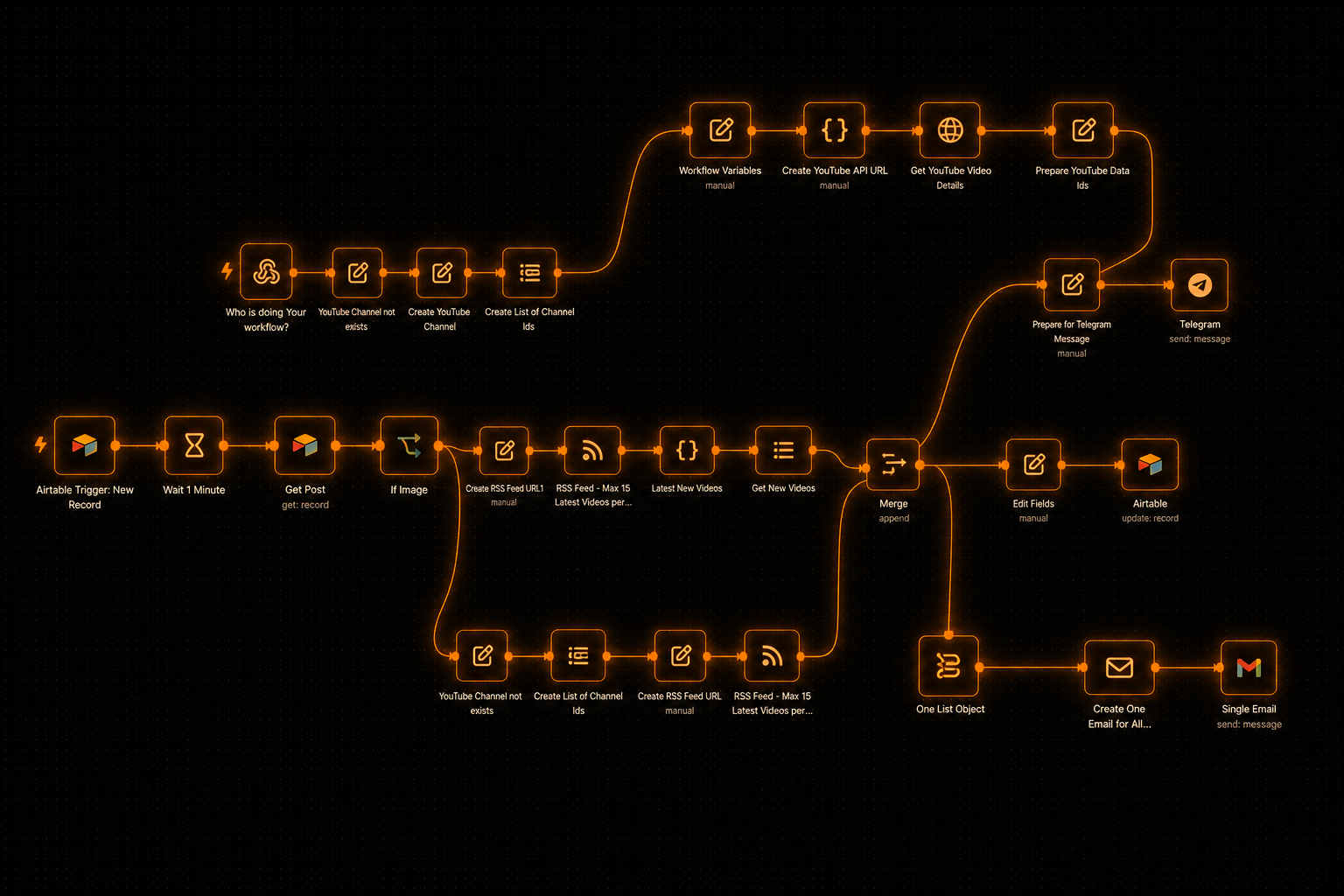
YouTube → content creation
New uploads become an archive, a ping, and a digest.
RSS watch, YouTube API enrich, Airtable upsert, Telegram per video, then OpenAI
builds one HTML email digest and Gmail sends it.
Airtable caption pipeline · production canvas
How they stay reliable
Most automations break.
A demo and a production pipeline are different products. These four structures ship in
every build — not as an upgrade.
01
Idempotency locks
Every payload is hashed on arrival and checked against a state store before anything expensive or irreversible runs. Duplicate webhooks are a fact of life, not an incident.
02
Dead-letter queues
Failures never retry inside the main thread. They route to an error sub-workflow that captures the input, the stack and the execution ID, then pages a human with a one-click replay.
03
Schema contracts
Third parties change response shapes without telling anyone. A validator sits behind every external call, so malformed data pauses the run instead of poisoning your database.
04
Human gates where it counts
Anything that spends money, emails a customer, or deletes a record waits for an approval step. Autonomy is a dial, not a switch.
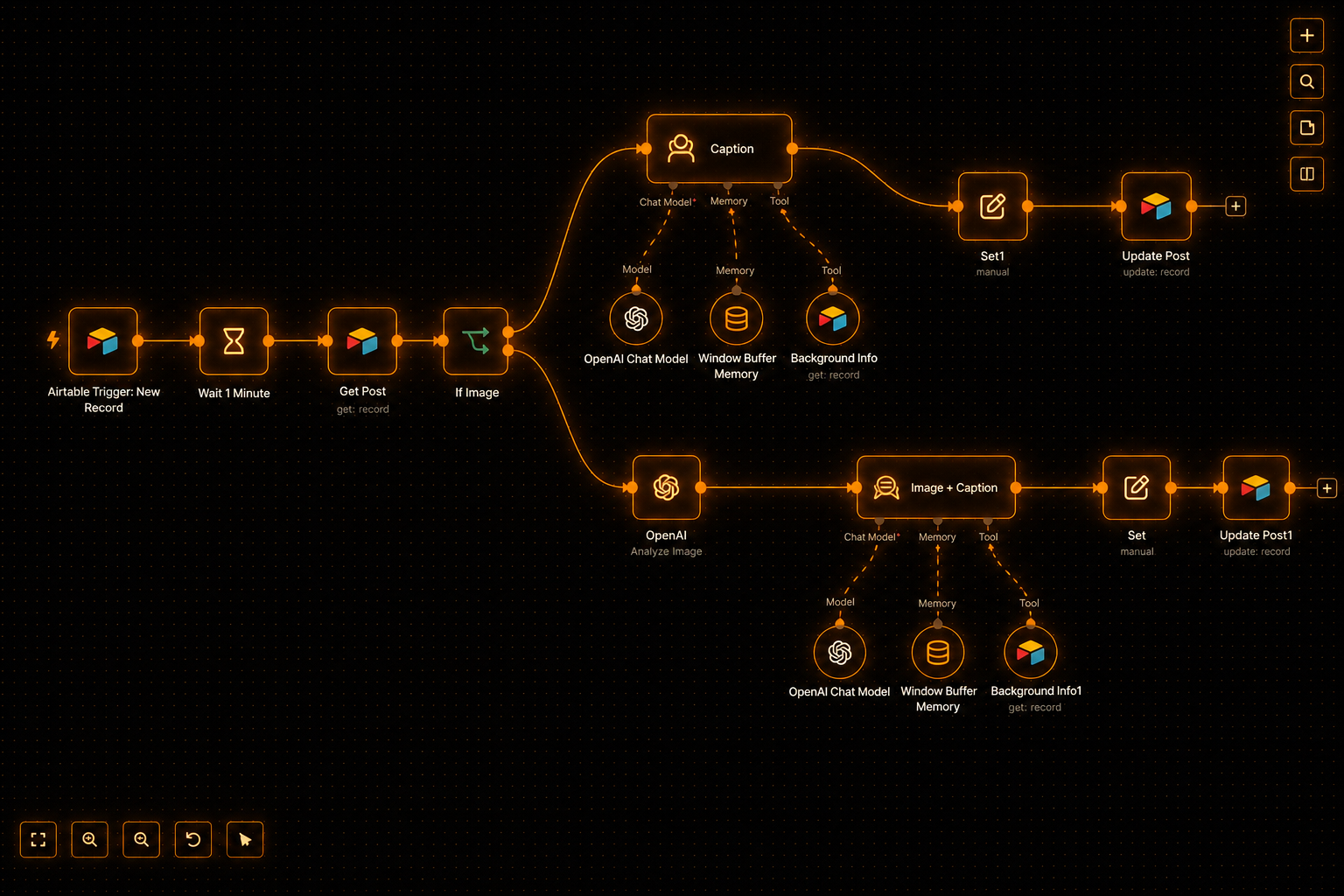
Airtable caption pipeline · production canvas
Switches, loops, and human gates — visible.
Production posture on the canvas: branching that waits where it should, not a
straight-line demo.
Which service fits
Fixed steps, or judgment?
You want automation
If you can already write down every step in order — do this, then this, then this — that is automation. Cheaper per outcome when the steps are fixed, and more predictable than an agent. A big multi-workflow stack can still cost real money — cheaper does not always mean a smaller invoice.
You want AI agents
If the steps change depending on what it finds, and a person currently has to think about it before acting, that is agentic. That lives at /agentic .
Most businesses need some of both. Start with the $500 Automation Audit if you are not sure.
Reliability levels
What reliability you get by tier.
Tier 1 already ships production posture. Higher tiers add observability, replay, and
department-scale monitoring — not a checkbox for “make it not break.”
Tier 1 Hardened pipeline
Idempotency, dead-letter queue, schema contracts, and human gates — in every build, not as an upgrade.
Tier 2 Observed and replayable
Everything in Tier 1, plus observability, replay tooling, and self-host setup so you can see and re-run failures.
Tier 3 Department scale
Everything in Tier 2, plus department-scale monitoring, deeper training, and a longer support window.
Faceless video pipeline
Reliability at scale, not a checkbox.
A multi-row pipeline that still has to survive retries, bad inputs, and the next API
change. This is the posture higher tiers buy.
Process map, go/no-go, topology, and a fixed-scope quote. If the map says agents, I offer the
$1,500 agentic pilot at /agentic — decline and the $500 still credits toward an agentic build.
Starting point
Automation Audit
Know if it is worth automating before you buy the build.
$500One-time
Three to five business days. A process map, a clear go/no-go on what is worth automating, and a fixed-scope quote for the build.
Map the bottleneck end to end — every step a person currently touches
Systems touched: what talks to what, and where the handoffs break
Go / no-go on each candidate — what earns a build, what stays manual
Rough node topology so you can see the shape of the pipeline
A fixed-scope quote for the build, priced off what I actually saw
If the map says agents: I offer the $1,500 agentic pilot at /agentic — decline and the $500 still credits toward an agentic build
Credit terms: the $500 comes off any project — automation or agentic — no expiry
The $500 comes off any project — automation or agentic. No expiry. If the audit says you need agents, I offer the $1,500 agentic pilot; decline and the credit still applies to an agentic build.
Meeting in, summary out — the manual loop that eats a morning every week.
YouTube transcript tool
I ship in the editor you see here.
Full production chrome — the WOW shot for three ways to build, not a rack photo
pretending to mean something.
Builds
Three ways to build.
Builds are value-priced after the $500 audit. I will not invent a sticker price before I see
the bottleneck. You get a fixed-scope quote once the work is mapped.
Build · Tier 1
1–2 weeks
Tier 1
One fixed pipeline.
Priced on scope
One workflow, known steps, adapted to your stack. Live in 1–2 weeks.
One pipeline with a clear start, middle, and finish
2–3 systems connected — the ones that job actually touches
Idempotency, dead-letter queue, schema contracts, and human gates in every build
Weekly progress reports during the build
30 days of support after launch
Credentials setup so your accounts, not mine, own the keys
Cloud n8n or your existing instance — self-host is an add-on at this tier
Deterministic nodes by default; light AI nodes only for extract or classify when they earn keep
A multi-workflow department stack with full hardening, monitoring, and deeper handoff. Live in 4–8 weeks.
Everything in Tier 2, plus:
Multi-workflow department stack — the jobs that share data and owners
Full hardening and monitoring at department scale
Self-hosted n8n included
90 days of support after launch
Deeper training so your ops team can own day-to-day changes
When judgment shows up — branching decisions a person currently has to think through — we route that piece to Agentic. Automation stays the fixed-script work.
Smallest real builds start around $2,500. Under that, buy a ready-made workflow and we adapt it to your stack.
Scope
Side by side.
What changes as the tier climbs — workflows, systems, reliability, support, and handoff.
Click a column to jump to that build.
Compare tiers
Compare
Tier 1
Tier 2
Tier 3
Workflows shipped
One pipeline
2–4 connected workflows
Multi-workflow department stack
Systems touched
2–3 systems
As many as the ops stack needs
Department tool surface, mapped and owned
Reliability
Idempotency, DLQ, schema contracts, human gates
+ observability and replay tooling
+ department-scale monitoring
Support window
30 days
60 days
90 days
Self-host
Cloud or existing instance · self-host add-on
Self-hosted n8n setup included
Self-host included
AI steps
Deterministic default · light extract/classify only
AI nodes where they earn keep
Same rule · judgment work routes to Agentic
Training / handoff
Credentials + runbook so you can operate it
Team training to operate and extend
Deeper training for ops ownership
Timeline
1–2 weeks
2–4 weeks
4–8 weeks
Compare
Tier 1
Tier 2
Tier 3
Workflows shipped
One pipeline
2–4 connected workflows
Multi-workflow department stack
Systems touched
2–3 systems
As many as the ops stack needs
Department tool surface, mapped and owned
Reliability
Idempotency, DLQ, schema contracts, human gates
+ observability and replay tooling
+ department-scale monitoring
Support window
30 days
60 days
90 days
Self-host
Cloud or existing instance · self-host add-on
Self-hosted n8n setup included
Self-host included
AI steps
Deterministic default · light extract/classify only
AI nodes where they earn keep
Same rule · judgment work routes to Agentic
Training / handoff
Credentials + runbook so you can operate it
Team training to operate and extend
Deeper training for ops ownership
Timeline
1–2 weeks
2–4 weeks
4–8 weeks
Workflow library
Off the shelf.
Each card is a working pipeline adapted to your stack and credentials during install.
From-prices shown on the cards. Under ~$2,500, buy a ready-made workflow; custom builds
start around that floor. I have built 600+ across the book of work; 500+ are still running —
built is not the same as still running, and I keep those counts separate on purpose.
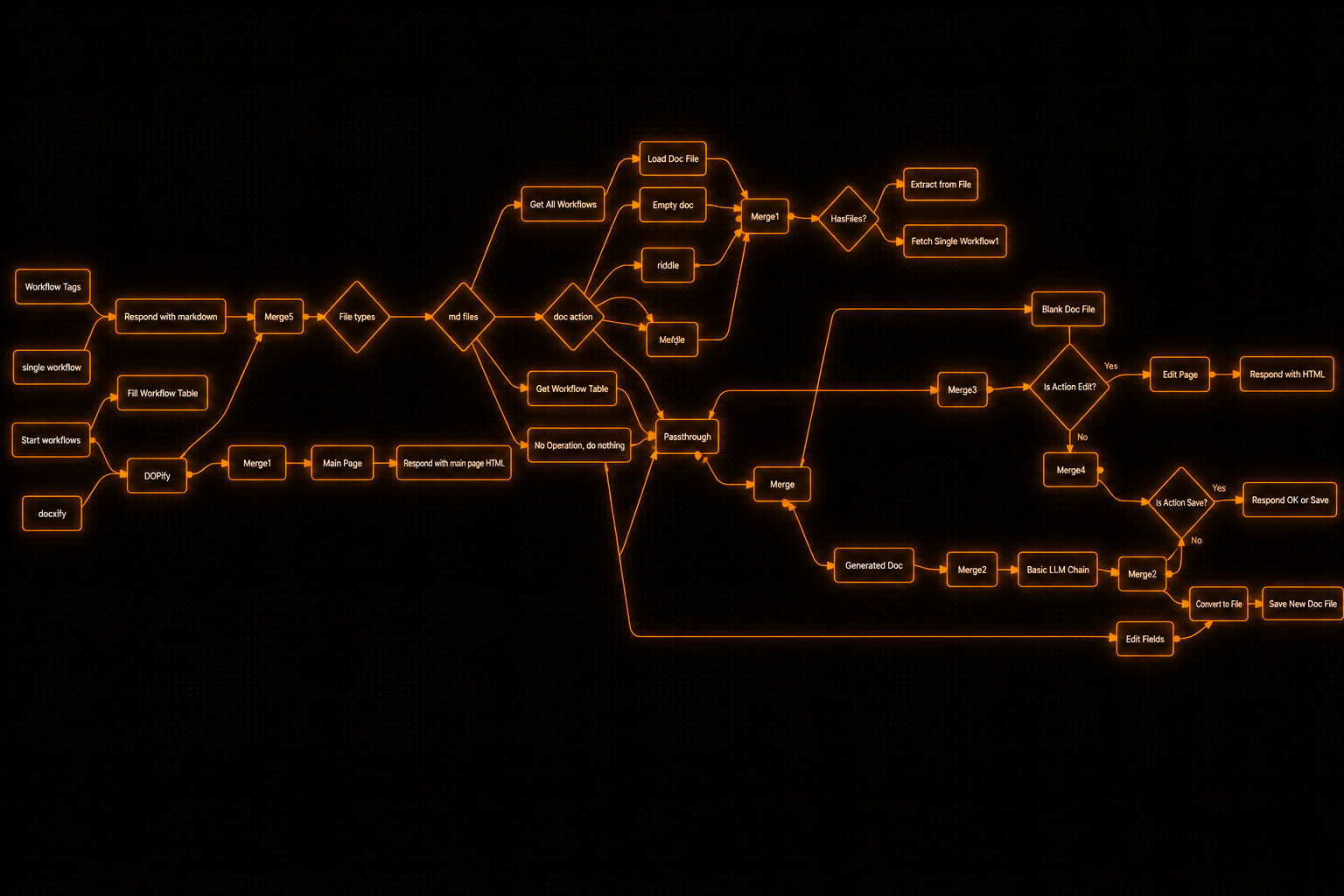
Docs / system flowchart
Curated from 600+ — the map, not the mood.
A docs and system flowchart from the shelf. This is what “off the shelf” looks like
before I adapt it to your stack.
Filter by job
24 shown418 nodes
Hours ranges are typical annual estimates and depend on your volume. Prices are from-figures adapted to your stack.
B-201MARKETING
Ecom Product Carousels
Drop product shots, get carousel-ready frames. Nano Banana handles the gen; the rail sizes, captions, and stages uploads so you're not hand-cropping SKUs all afternoon.
Email-to-content: a long note hits a label, the rail cuts it into posts, shorts briefs, and a newsletter block — queued for one-tap sign-off, not auto-publish.
Brand-aware blogger: pulls trend clusters, checks your existing corpus, drafts posts that don't cannibalize what you already rank for, and holds publish behind review.
Creator playbook rail — watches what's landing in your niche, reverse-engineers the structure, and drafts your version in your voice. Pattern library, not plagiarism.
Productized MCP standup — ElevenLabs or Supabase tooling wired into your agent stack with auth, tool schemas, and a smoke-test pass so Cursor actually can call it.
Bidirectional status and field sync with conflict rules you set once. Notion stays the wiki; ClickUp stays the board; neither becomes the other's junk drawer.
Failed runs land in a dead-letter queue, get classified, and fire a human-readable email plus Slack ping with payload + retry link. Silent failures stop being silent.
Calendly book → LinkedIn + Perplexity enrich → CRM write. You walk into the call knowing who they are, what they sell, and what to ask — without a research hour.
Home-service quote gen from curb photos and a short intake. Pulls your rate card, drafts line items, and emails a scoped estimate ready for a human stamp.
Apollo list in, Instantly-ready sequences out — research snippets, personalization lines, and suppression checks so you don't burn the domain on bad data.
Autoresponder that actually answers FAQs, books slots, and escalates the weird stuff to a human with the thread already summarized. After-hours coverage without a ghost reply.
Fireflies overseer pattern: transcript in, decisions + action items out, filed to the right Notion page with owners tagged. The meeting stops dying in the recording folder.
Tomorrow's attendees, LinkedIn context, last-meeting notes, and open loops — one brief before the first call. You stop Googling people in the last five minutes.
Watches the finance inbox, OCRs line items, classifies against your chart of accounts, and drops PDFs into the right Drive folder with a review queue for the weird ones.
CV against the real scorecard, screening questions worth asking, polite reject at volume. Aligned with the recruitment-screening graph — no ghosting, no blank-sheet reviews.
Scores a CV against a role template, returns strengths, gaps, and a short interviewer brief. Fast first pass before a human spends an hour on a no-fit.
Pipelines drift after launch. Watch protects what exists. Keep Current ships the next
workflows on a cadence. Keep Building covers department-scale ops.
Full price · cancel anytime
Refer someone who signs a 3-month minimum and you get 2 more months free. Works on any plan, and it stacks with annual.
Retainer · Watch
Retainer
Watch
Keep the pipelines honest while you run the business.
From $3,000 per month
$3,000
From $2,250 per month
25% off · 3-month minimum
$3,000
From $1,875 per month
Billed $22,500/yr · 25% off + 2 months free
Monitoring, dead-letter handling, and a small change budget so production does not rot after launch.
Uptime and error monitoring on the workflows that already ship
Dead-letter handling — failed runs get reviewed and cleared, not ignored
A small monthly change-request budget for tweaks that keep the pipeline true
No new workflow cadence at this tier — Watch protects what exists
Department-scale ops, watched and extended as the business moves.
From $15,000+ per month
$15,000+
From $11,250+ per month
25% off · 3-month minimum · priced on system size
$15,000+
From $9,375+ per month
Billed $112,500+/yr · 25% off + 2 months free · priced on system size
Multi-workflow territory with continuous build capacity. Priced on the size of the system — the numbers below are the floor.
Everything in Keep Current, plus:
Multi-workflow department stacks under continuous care
Higher change and new-workflow volume — Keep Building means the roadmap moves
Incident response when a pipeline fails outside business hours
Weekly calls, plus async when a launch is live
Optional agent supervisor territory: when judgment shows up, that piece routes to Agentic. This retainer does not smuggle agent pricing into automation.
Priced on the size of the system — the $15,000+ monthly is the starting band, not a ceiling
Logins and API keys for every system the pipeline has to touch — CRM, inbox, sheets, ERP, whatever owns the data. I build on your accounts.
API access
Working API access or a clean webhook path. If a tool has no API and no export, say so early — that changes the design, not just the timeline.
Process owner
Someone who does the job today and can walk me through the real steps, including the ugly ones. Automations fail when the map is a fantasy.
Sandbox / sample data
A safe place to test and enough real sample payloads that the edge cases show up before production. Sanitized-to-death samples hide the bugs.
One decision-maker
Someone who can approve scope without a committee. Automation builds stall on approval chains, not on node configuration.
Fast feedback
Turnarounds measured in days. I ship in the open; stalled feedback is the main thing that stretches a timeline.
Airtable caption pipeline · the deal
The deal
Before we start.
Audit credit, no expiry
The $500 Automation Audit comes off any project — automation or agentic. No countdown. You keep the process map and go/no-go either way. If the map says agents and you skip the $1,500 agentic pilot, the $500 still credits toward an agentic build.
JSON ownership
n8n workflows are JSON files you own outright. No hostage platform, no per-seat tax to keep your own pipelines running. Hand them to another developer tomorrow and they still run.
Payment
After the quote: 50/50 on smaller builds, or milestones on larger stacks. We pick the structure when scope is locked — not before.
Self-host posture
Cloud n8n is fine for Tier 1. Tier 2 and Tier 3 include self-host setup so the graph lives on your infrastructure. Credentials stay on your accounts either way.
Support by tier
30 days on Tier 1, 60 on Tier 2, 90 on Tier 3. After that, Watch / Keep Current / Keep Building if you want ongoing care.
No printed build prices
Builds are value-priced after the $500 audit. Smallest real builds start around $2,500 — under that, buy a ready-made workflow and we adapt it. I will not invent a sticker price before I see the bottleneck.
FAQ
Straight answers.
Can this be automated?
What is the difference between automation and AI agents?
Automation follows a fixed script: do this, then this, then this, every time, in the same order. An agent decides its steps as it goes, because the right move changes depending on what it finds. Automation is cheaper per outcome when the steps are fixed, and more predictable than an agent. If a person currently has to stop and think before acting, that is agentic — that lives at /agentic. Most businesses need some of both.
How do I know if my process is a good candidate for automation?
If you can already write every step down in order with almost no branching, it is a good candidate. Clear inputs, clear outputs, systems with APIs or webhooks, and a person who hates doing the same clicks every week. The $500 Automation Audit is the start — process map, go/no-go, topology, and a fixed-scope quote so you stop guessing before a bigger check.
What kinds of work are bad candidates for automation?
Open-ended judgment with no clear success criteria. Jobs where being wrong once is expensive and hard to undo. Processes that change every week because nobody has written the real steps down. Tools with no API and no reliable export. If the hard part is deciding, not clicking, I will send you to Agentic instead of selling you a brittle workflow that pretends to think.
Can you automate work that spans multiple tools like a CRM, inbox, and spreadsheet?
Yes — that is most of the job. Tier 1 usually touches two or three systems. Tier 2 and Tier 3 connect whatever the ops stack actually uses. If a tool has an API, a webhook, or even a clean export path, there is almost always a way in. The audit maps which handoffs are worth wiring and which should stay manual.
Do I need n8n already, or can you start from nothing?
Either. I can stand up cloud n8n, use an instance you already have, or include self-host setup on Tier 2 and Tier 3. What matters is that the workflows end up as JSON on accounts you control. I am not going to trap your ops graph inside a black-box account you cannot leave.
Should I buy automation or an AI agent for my business?
Buy automation when the steps are fixed. Buy an agent when the steps change based on what it finds. Cheaper does not always mean a smaller invoice — a department-scale multi-workflow stack can still cost real money — but per outcome, fixed scripts beat agents when the path never branches. Unsure? Start the $500 Automation Audit. I will not upsell you into Agentic to inflate a build.
What is the $500 Automation Audit, and what do I get?
Three to five business days of process mapping: the bottleneck, systems touched, go/no-go on what is worth automating, a rough node topology, and a fixed-scope quote for the build. You keep the deliverables either way. The $500 comes off any project — automation or agentic — with no expiry. If the map says you need agents, I offer the $1,500 agentic pilot at /agentic; decline and the credit still applies to an agentic build.
How many automations have you built, and are they still running?
I have built 500-plus automations. More than 600 have shipped across the book of work; 500-plus are still running in production. Those are separate counts on purpose — built is not the same as still running, and I will not blur them. Aggregate client busywork deleted across that work sits at 35,000-plus hours saved. I do not invent per-client metrics to dress that up.
Can a small business afford custom automation, or is this only for enterprise?
Affordability tracks the pain of the bottleneck, not your headcount. A five-person shop drowning in the same weekly report is a better fit than a thousand-person company with no single painful job. Smallest real builds start around $2,500. Under that, buy a ready-made workflow and we adapt it to your stack. Start with the $500 Automation Audit if you are not sure the math works.
How do I hire Spurlock Studios for automation work?
Start the $500 Automation Audit from the contact page. From there it is me — William Spurlock — not a sales floor handing you to a project manager. Bring the process, the tools it touches, and one decision-maker. I will tell you whether you need a ready-made workflow, a scoped build, or Agentic.
What it costs
Why don't you print fixed prices for automation builds?
Because the invoice should track the bottleneck I actually see — systems touched, failure modes, self-host needs, and how messy the real data is — not a sticker I invent from a contact form. Builds are value-priced after the $500 audit. You get a fixed-scope quote before I write nodes. No printed ladder that pretends every CRM sync costs the same.
What is the minimum cost for a real automation build?
Smallest real builds start around $2,500. Under that, buy a ready-made workflow and we adapt it to your stack — fighting a custom build below that floor usually costs more in discovery than you save. The $500 Automation Audit tells you which path you are on before you buy.
Does the $500 Automation Audit fee count toward a build?
Yes — the full $500, with no expiry. It comes off any project — automation or agentic — not just automation builds in a ninety-day window. You keep the process map and go/no-go either way. If the audit says agents and you decline the $1,500 agentic pilot, the credit still applies to an agentic build.
How much do automation retainers cost per month?
Watch is $3,000 a month for monitoring, dead-letter handling, and a small change budget. Keep Current is $6,500 a month for a larger change volume and new workflows on a cadence. Keep Building starts at $15,000-plus a month for department-scale stacks — priced on the size of the system. Commit to three months and take 25 percent off. Go annual and stack that same 25 percent with two months free.
Can I get a discount if I commit to an automation retainer longer than a month?
Yes. Monthly is full price, cancel anytime. A three-month minimum takes 25 percent off. Annual takes that same 25 percent off and adds two months free — Watch lands at $1,875 a month billed annually ($22,500/yr), Keep Current at $4,063 ($48,750/yr), Keep Building at $9,375-plus ($112,500-plus/yr). Longer terms cost less per month once you know you are staying.
Is there a referral bonus on automation retainers?
Yes. Refer someone who signs a three-month minimum and you get two more months free on your own plan. It works on Watch, Keep Current, and Keep Building, and it stacks with annual. Same stacking language as the other services — you send business my way, I send months back yours.
How does payment work for automation builds?
After the quote is locked: 50/50 on smaller builds — half to start, half at launch — or milestones on larger stacks. The audit is one-time up front. Retainers bill monthly (or under the term you pick). I do not take a deposit against a mystery scope.
Do I pay for n8n hosting and API usage on top of your fee?
Yes, on your own accounts. Cloud n8n, self-hosted compute, and any third-party API costs sit on invoices you control. I do not mark those up or route them through Spurlock Studios. That is also why credentials and ownership stay with you from day one.
What is cheaper — automation or an agent — for the same outcome?
When the steps are fixed, automation is usually cheaper per outcome and easier to predict. That does not mean the invoice is always smaller — a Tier 3 department stack can still be a serious build. Agents cost more to design and to keep honest because judgment needs evaluation and oversight. I will push you toward automation when the script holds, and toward /agentic when it does not.
What if the audit says I need agents, not fixed automation?
I tell you straight and offer an upgrade into the $1,500 agentic pilot at /agentic. If you decline, the $500 audit still credits toward an agentic build — same no-expiry credit that applies to any project. You keep the process map either way; the audit is not wasted if the lane shifts.
When should I buy a ready-made workflow instead of the audit or a custom build?
Buy a ready-made when the job already matches a shelf workflow and you just need it adapted to your stack — usually under the ~$2,500 custom-build floor. Start the $500 audit when you need a process map, go/no-go, topology, and a fixed-scope quote before you commit. If you already know the scope, book a build tier scoping call after the audit — not as a free start.
How it runs
Why do you build automations in n8n instead of Make.com?
I hold all Make.com AI Automation certifications and I still ship a lot of work on Make when that is the right tool. For production graphs I own long-term, n8n wins on self-host, JSON ownership, and how the platform is moving — I collaborate directly with the n8n team. You get workflows as files on your infrastructure, not a seat tax you cannot leave. If Make is already your stack and the job fits, I will say so instead of forcing a migration for ego.
Should I run n8n in the cloud or self-host it?
Cloud is fine for a single Tier 1 pipeline when you want speed. Self-host when the data should not leave your network, when you want full control of upgrades, or when the graph is big enough that residency matters — Tier 2 and Tier 3 include self-host setup for that reason. Either way, credentials stay on your accounts and the JSON stays yours.
Who owns the n8n workflow JSON after you build it?
You do, outright. Workflows are JSON files on your instance. No vendor lock-in, no per-seat tax to keep your own pipelines running, no hostage export screen. You could hand the files to another developer tomorrow and they would still run.
What hardening is included in every automation build?
Every build ships with idempotency, a dead-letter queue, schema contracts, and human gates on anything with a real-world side effect. Tier 2 adds observability and replay tooling. Tier 3 adds department-scale monitoring and deeper training. Hardening is not an upsell — brittle happy-path demos are how automations earn a bad name.
What happens when an automation fails or a run lands in the dead-letter queue?
Failed runs get parked in the dead-letter queue instead of silently dropping. You (or I, under a retainer) review the payload, fix the cause, and replay when it is safe. Observability on Tier 2 and above makes that visible without digging through raw logs. Watch and higher retainers include ongoing dead-letter handling so production does not rot.
Do your automations use AI nodes, or only deterministic steps?
Deterministic by default. Light AI nodes for extract or classify when they earn keep — for example pulling fields from messy email. I do not glue a model onto a fixed script for marketing copy. When the job needs real judgment mid-flight, that piece belongs in Agentic, not hidden inside an automation invoice.
How long does it take to ship an automation build?
Tier 1 lands in 1–2 weeks. Tier 2 in 2–4 weeks. Tier 3 in 4–8 weeks. The Automation Audit is three to five business days before any of that. Timelines assume credentials, a process owner, and fast feedback — stalled access stretches the calendar, not a surprise invoice.
What do you need from me before an automation build starts?
Credentials, API access, a process owner who does the job today, sandbox or real sample data, one decision-maker, and feedback in days. Missing those does not always stop the work — it just means we fix access and clarity first. The $500 Automation Audit surfaces gaps before I start wiring nodes.
Can my team change the workflows after you hand them off?
Yes. That is the point of JSON ownership and training. Tier 1 ships with a runbook and credentials setup. Tier 2 and Tier 3 include deeper training so your ops team can extend what shipped. Under Keep Current or Keep Building I can keep shipping changes with you — but you are never locked out of your own graph.
How do your automation receipts compare — builds shipped vs still running vs hours saved?
Three different numbers, kept separate on purpose. I have built 500-plus automations; more than 600 have shipped across the book of work; 500-plus are still running. Aggregate client busywork deleted sits at 35,000-plus hours saved — that compounds across clients, so it is higher than any one personal hours figure and I will not pretend it is a single-client case study. Ask for the distinction if a competitor blurs built, running, and saved into one vanity metric.
Describe the manual process and the systems it touches. Start with the $500 Automation Audit —
process map, go/no-go, and a fixed quote. If the map says agents, the path is /agentic.