Ask ChatGPT who to hire in your category. If it names a competitor, that is not a branding
problem — that is a visibility problem. The $500 audit shows you exactly what the models say.
Answer and generative engine optimisation — citation share, daily answer-engine content, publishing calendar, and social Draft banks before anything posts. AI Visibility Audit $500; Growth from $3,500/mo.
How you show up
Four things the models measure.
AI search does not rank pages the old way. It figures out who you are, then decides whether
to name you. These four signals decide if a model can put you in an answer with confidence.
01 Schema coverage
00
The code that tells AI who you are, what you sell, and how to cite you.
02 llms.txt & machine surface
00
A plain file machines can read instead of guessing from your page design.
03 Entity consistency
00
Your name, founder, and address saying the same thing everywhere AI looks.
04 Citation share
00
How often you show up in AI answers for the questions that make you money.
01 Schema coverage
00
The code that tells AI who you are, what you sell, and how to cite you.
02 llms.txt & machine surface
00
A plain file machines can read instead of guessing from your page design.
03 Entity consistency
00
Your name, founder, and address saying the same thing everywhere AI looks.
04 Citation share
00
How often you show up in AI answers for the questions that make you money.
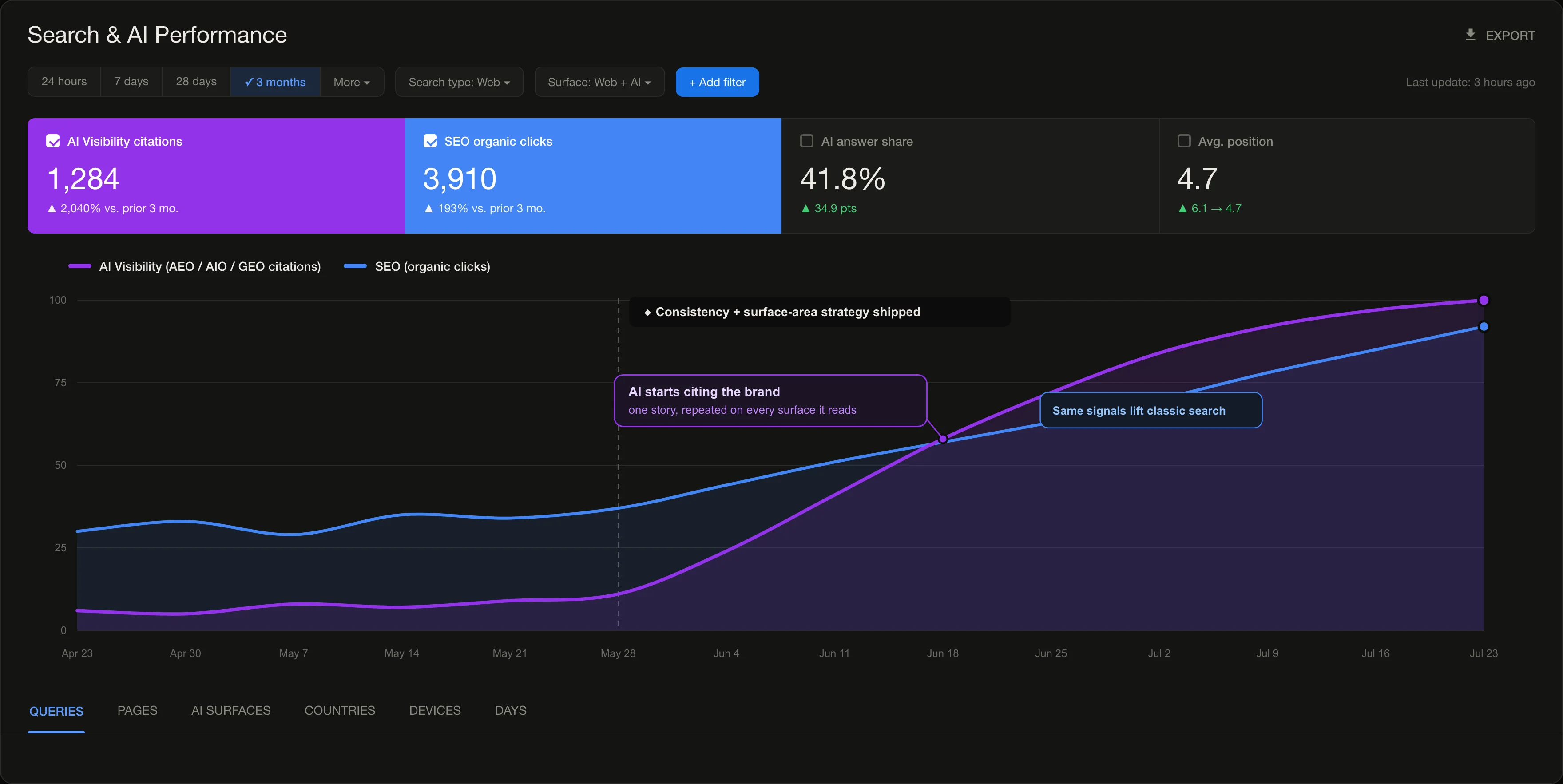
Search · AI performance
Search & AI performance
SEO and AI citation traffic, measured together.
Same GSC-style surface — purple for AI Visibility citations, blue for organic clicks.
Search · AI performance
Who gets named
ChatGPT“best HVAC near me”→Competitor APerplexity“who builds AI automation”→Competitor BClaude“music website designer”→Competitor CGoogle AI“AEO agency for SMBs”→Competitor DChatGPT“schema markup expert”→Competitor EPerplexity“custom artist website”→Competitor FClaude“llms.txt setup service”→Competitor GGoogle AI“generative engine optimization”→Competitor HChatGPT“best HVAC near me”→Competitor APerplexity“who builds AI automation”→Competitor BClaude“music website designer”→Competitor CGoogle AI“AEO agency for SMBs”→Competitor DChatGPT“schema markup expert”→Competitor EPerplexity“custom artist website”→Competitor FClaude“llms.txt setup service”→Competitor GGoogle AI“generative engine optimization”→Competitor H
Visibility scanner
Point it at a domain.
Drop your domain. I queue the checks the models actually care about — then you book the
audit to get the ranked fix list.
Sample readout · spurlockstudios.com
Ready
/llms.txt Found · 200 OK
Organization schema Complete
Person / founder schema Complete
Entity consistency Verified
Citation density 8.4 / 10
Answer-ready headings 3 gaps found
In review · DomainIn review
/llms.txtPending
Organization schemaPending
Person / founder schemaPending
Entity consistencyPending
Citation densityPending
Answer-ready headingsPending
Domain logged. The $500 audit turns this queue into ten ranked fixes and a walkthrough
call — and credits the fee if you continue.
Same machine I run for growth brands today: daily blog batches, a calendar you can see,
and social Drafts before anything posts. Monthly is full price; 3 months+ takes 25% off;
annual stacks that plus two months free.
How citations get builtMaps to tiers
1Track
What the models say about you — and who they name instead.
Tier 1+
2Calendar
Daily answer-engine blog + Airtable slots — planned vs published, always visible.
Tier 1+
3Draft bank
Social kits batched in 20–50+ packs as Draft / demos. Posted only after you greenlight.
Tier 1+
4Measure
Citation share on a trend, not a one-shot PDF — and live posting on Tier 3.
Tiers 1–3
Full price · cancel anytime
Send me a client who signs a 3-month minimum and I credit you two months free on your own plan. Works on any Visibility tier, and it stacks with annual.
Growth · Tier 1
Retainer
Tier 1
The calendar runs.
From $3,500 per month
$3,500
From $2,625 per month
25% off · 3-month minimum
$3,500
From $2,188 per month
Billed $26,250/yr · 25% off + 2 months free
Daily answer-engine blog, a live publishing calendar, and social creatives staged as drafts — the operating model I already run for growth brands.
Daily blog cadence — 7 answer-shaped posts a week, authored in two batch days (Wed covers Mon–Wed; Sun covers Thu–Sun), not one lonely post at a time
Publishing calendar in Airtable — every slot shows planned vs published so you always know what is queued and what already went live
Social kits batched in packs of 20–50+ (X, TikTok, Snap-ready) and loaded into your content bank as Draft / demo posts
Draft ≠ posted — demos sit for review and scheduling; nothing goes live until you greenlight it
Citation tracking across ChatGPT, Perplexity, Claude, and Google AI — who they name, and who they name instead
Entity and schema hygiene on the site you already have (or right after a Website build)
A Website build — Creator Site $3,500, Business Site $8,000, or Product Platform $23,000 under Websites — ships the AI-readable foundation: schema, sitemap, llms.txt, entity basics, and answer-shaped pages on higher tiers. Visibility attaches monthly from $3,500 and owns the discovery engine after launch: citation tracking, a daily answer-engine blog batched by the week, a publishing calendar, and social creatives staged as Draft / demo posts until you greenlight what goes live. You can also buy Visibility with no build at all if your site is already decent.
15% off combined monthly with Website Studio
Website Studio Grow at $7,500/mo plus Visibility Growth Tier 2 at $8,500/mo is $16,000; 15% off brings it to $13,600 monthly before term discounts.
Summer 2026 attach offer: any build tier, attach Visibility Growth within 30 days of launch on a 3-month minimum or longer, and the first of those months is included — ends September 30, 2026. The 15% bundle stacks with quarterly/annual term discounts and the referral bonus.
Also available
Visibility on top of a build
Websites makes the site readable. Visibility decides whether the models name you.
Websites owns pages, design, motion, CRO, and on-site analytics
Visibility owns citation share and discovery intelligence
The $500 audit credits toward either a Website build or a Visibility plan
Summer 2026 attach: any build tier, within 30 days of launch, 3-month minimum — first of those months included; ends September 30, 2026
Bundle at 15% off combined monthly with Website Studio
Stacks with quarterly/annual term discounts and the referral bonus
Attach Visibility Growth within 30 days of your site going live, on the 3-month minimum or any longer term, and the first of those months is on me. Any build tier. This is a Summer 2026 offer, not a standing discount — after it closes, the first month is billed like any other.
Any build tier — Creator Site, Business Site, or Product Platform
Visibility Growth has to start within 30 days of launch
3-month minimum or longer, which already carries 25% off
First of those months included — you commit to three and pay for two
Stacks with the 15% Website Studio + Visibility bundle and the referral bonus
Pick Website Studio, Visibility Growth, and a term. Bundle is 15% off combined monthly.
Summer attach (first month included on 3-month+) ends Ends September 30, 2026.
Stack (full)
$0
Bundle (−15%)
$0
Summer attach
—
What happens next
What actually happens.
Day 1Audit
You pay $500 and I audit how the models see you.
Day 5Fix list
You get the ranked fixes and the walkthrough call. The $500 credits toward a Visibility plan or a Website build. If the site itself is the blocker, that build happens under Websites first.
Week 1Baseline + calendar
Plan starts. I wire citation tracking, stand up the publishing calendar, and record where you actually stand before the first batch ships.
Week 2First bank
First blog week lands via the two batch days. First social pack loads into Airtable as Draft / demo posts — ready for review, not auto-posted.
Mo 2–3Citations
Citations typically start moving 30–60 days after the entity, schema, and answer-content work compound. This is not a same-week promise.
FAQ
Straight answers.
How AI search works
What is answer engine optimization and is it different from SEO?
Yes, and the difference is the whole game now. SEO earns you a spot on a results page a human scrolls through. AEO earns you a spot inside the answer an AI model already wrote and handed over — no scrolling, no comparison shopping, just your name or your competitor's. Same instinct as SEO. Different targets: structured data, entity clarity, and answer-shaped content instead of just keywords.
What do AEO, GEO, and AIO actually mean, and are they three different things?
AEO is answer engine optimization — getting picked for direct answers. GEO is generative engine optimization, the same goal phrased around generative AI models specifically. AIO is AI optimization, the umbrella term that covers both. In practice I treat them as one job: build a site the models can read, understand, and trust enough to cite. Which acronym you use matters less than whether your site actually earns the citation.
Why does ChatGPT recommend my competitor instead of me?
Because the model found their name attached to a clear answer and could not find yours. AI models cite whoever has the clean, consistent, machine-readable signal — the right schema, a matching name and description everywhere, content shaped like the answer to the question being asked. If your competitor did that work and you did not, the model has no reason to gamble on you. That is fixable, and it does not take a total rebuild to fix.
How is getting cited in an AI answer different from ranking on Google's first page?
A Google ranking is a list of ten options a person still has to click and judge. An AI citation is the model handing over one name as the answer, often with no list at all. Ranking third on Google can still get you the customer. Getting skipped by the AI's single answer usually means you get nothing from that search. It is a smaller stage with a much higher cost of not being on it.
Can my website look great and still be invisible to ChatGPT and Perplexity?
Yes, easily, and it happens constantly. A model does not see your fonts, your animation, or your photography — it reads code, structured data, and text. A site can win design awards and still ship zero schema, no llms.txt, and inconsistent entity information, which makes it functionally unreadable to AI. Looking good for humans and being legible to machines are two separate jobs, and most sites only finished the first one.
What does an AI model actually read on my site before it decides to recommend me?
Mostly the parts a human visitor never notices. Structured data that spells out who you are and what you sell. A clean, consistent entity — your name, founder, and address matching everywhere. Answer-shaped text that directly resolves a specific question instead of vague marketing copy. Design, color, and motion do nothing for this. It is the exact checklist I run at Spurlock Studios, because the code has to say it plainly or the model treats you as if you do not exist.
Why doesn't ranking well on Google guarantee I show up in Google AI Overviews?
Because AI Overviews is doing a different job than the classic ranking algorithm. Traditional SEO rewards links, keywords, and authority signals built for a human clicking through blue links. AI Overviews looks for a single, extractable, well-structured answer it can quote directly. You can rank on page one and still get skipped by the Overview, because your content was never written or coded in a way the model could lift cleanly.
Is AI search really replacing Google for people searching for a business like mine?
Not replacing it outright, but eating a real share of it, and that share grows every month. More people are asking ChatGPT, Perplexity, and Google's own AI Overviews the exact questions they used to type into a search box, and getting one answer instead of ten links. If you are only optimized for the old search box, you are handing every one of those AI-answered queries to whoever showed up prepared.
What is generative engine optimization, and why does it matter for my business?
Generative engine optimization is structuring your site so generative AI models — ChatGPT, Claude, Perplexity — can read it, trust it, and quote it in an answer. It matters because those models are becoming a real referral channel, and unlike a search results page, there is often only one name in the answer. GEO is the work I do at Spurlock Studios to decide whether that one name is yours.
Should I wait and see if AI search is a fad before I spend money fixing this?
No. This is not a maybe. ChatGPT, Perplexity, and Google's own AI Overviews are already answering the questions your buyers used to Google, and citations there typically start showing up 30 to 60 days after the entity and schema work ships. Every month you wait is a month a competitor gets named in your place, and once they build citation history, it gets harder to displace them. Fix it early, not after the lead drop tells you to.
Getting picked
What is schema markup, and why does it matter for AI search?
Schema markup is code embedded in your site that states facts about your business in a format machines read without guessing — your name, what you sell, your founder, your service area. Without it, a model has to infer those facts from marketing copy, and it often infers wrong or gives up entirely. With clean schema, the model has a direct, structured fact to hand back when someone asks about you. It is the fix with the biggest payoff of anything I check in a Spurlock Studios audit.
What is llms.txt, and do I actually need one on my site?
llms.txt is a plain text file that tells AI models what your site is and where to find the parts that matter, instead of making them guess from your page design. Think of it as a cheat sheet built for machines, not humans. You do not strictly need one to exist online, but every site I audit without one is leaving free, easy signal on the table. It is one of the fastest fixes on the list, and it never expires.
What does 'entity consistency' mean, and why do AI models care about it?
It means your business name, founder, address, and description say the exact same thing everywhere a model might find them — your site, your directory listings, your social profiles. Models cross-check this before they cite you, because citing the wrong business is a mistake they are built to avoid. Something as small as your name being written two different ways in two different places can be enough for a model to stay quiet instead of guessing.
What makes a page 'answer-shaped' instead of just well-written?
An answer-shaped page states the direct answer to a specific question in the first sentence, then backs it up — the way I am answering you right now. A well-written page can still wind up for three paragraphs before it gets to the point, which is fine for a human reader and useless to a model looking for something to quote. I build pages around the exact questions your buyers type into ChatGPT or Google, answered plainly at the top.
How do I actually measure whether ChatGPT or Perplexity are citing me?
You ask the models directly, log what they say, and track it over time — that is exactly what the citation-share signal in a Spurlock Studios audit measures. Manually, that means running your key buyer questions through ChatGPT, Perplexity, Claude, and Google AI on a schedule and recording who gets named. On a growth plan, that tracking runs on a dashboard instead of a spreadsheet, updated at least every two weeks so you see the trend, not just one snapshot.
How long does it take to start getting cited by AI search after I fix my site?
Usually 30 to 60 days after the site and entity work ships. That is not a guess — it is roughly how long it takes AI models to recrawl, re-evaluate, and start trusting a corrected entity. Anyone promising results in a week is either overselling or not talking about actual AI citations. The fix itself happens fast. The models catching up to it takes a bit longer.
What happens if I just do nothing about AI visibility?
Your competitors who did fix it keep getting named, and you keep not existing in that conversation. AI answers are already replacing a real share of the searches your buyers used to type into Google, and a model with no clean signal about you will simply recommend whoever it can verify instead. Nothing breaks or crashes on your end. You just quietly stop showing up where the decision is actually getting made.
Do I need a blog to get picked by AI search, or is that overkill for my business?
For most growth brands, a thin site with three evergreen pages is not enough once competitors publish answer-shaped content every week. Visibility Growth Tier 1 already includes a daily answer-engine blog — seven posts a week, written in two batch days — because models re-check sources that keep showing up with clear answers. If you truly have nothing new to say, we tighten the calendar. We do not pretend two posts a month is a growth engine.
Can I fix AI visibility myself with a plugin, or does it need custom code?
A plugin can bolt on basic schema, but it will not fix entity inconsistency across your directory listings, write answer-shaped content, or build a proper llms.txt tailored to your business. Some of it is genuinely do-it-yourself if you have the time and the technical patience for it. Most owners who try the plugin route end up with partial schema and no entity work, which is why I still find broken markup on sites that already handled their SEO.
Is it worth fixing my old site, or should I just rebuild it from scratch?
Depends on how bad the foundation is, which is exactly what the $500 Spurlock Studios audit tells you before you spend real money either way. If the bones are decent, a Visibility plan can fix discovery without a rebuild. If the code is old enough that it cannot support proper schema or fast load times, the rebuild lives under Websites — Creator Site $3,500, Business Site $8,000, or Product Platform $23,000. I will tell you straight which one you actually need.
Can I buy Visibility without a website build?
Yes. Plenty of clients already have a decent site and only need discovery intelligence — citation tracking, the content that earns the citation, and the systems that keep citation share from eroding. Visibility is a monthly service starting at $3,500. You do not have to buy a Spurlock Studios build to start.
Working with me
How much does the AI visibility audit cost, and what do I get for it?
$500, delivered in 5 business days. You get a 45-minute walkthrough call and ten ranked fixes in plain English, not a 40-page PDF nobody reads. At Spurlock Studios I run your business through ChatGPT, Perplexity, Claude, and Google AI, record exactly what they say, note who gets named instead of you, and check whether your site is even readable to them. You keep the fix list whether or not you hire me for anything else.
Does the $500 audit fee actually come off the price if I hire you for more?
Yes, in full, with no expiry. The $500 credits against a Website build or the first month of any Visibility plan, whenever you decide to start — next week or next year. There is no fine print shrinking the credit over time. You are not paying twice. You are paying $500 to see the problem clearly, then applying that same $500 toward fixing it.
Should I start with the audit, or go straight to a full build?
If your current site embarrasses you or does not exist yet, skip the audit and go to Websites — Creator Site starts at $3,500. There is nothing useful to audit on a blank or broken foundation. If you already have a site and just are not sure why AI is not naming you, start with the $500 Spurlock Studios audit. It tells you what is broken before you spend real money on the wrong fix, and the fee credits toward a Website build or a Visibility plan.
What is the difference between a one-time build and a monthly growth plan?
Builds are a Websites product — Creator Site $3,500, Business Site $8,000, Product Platform $23,000. Visibility is monthly only, starting at $3,500/mo. It owns the discovery engine after the site exists: citation tracking, a daily answer-engine blog batched by the week, a publishing calendar, and social creatives staged as Draft / demo posts until you greenlight what goes live. A build ships the AI-readable foundation. Visibility keeps the models naming you — and fills the calendar that makes that possible.
What is the difference between a demo / Draft post and a posted post?
A Draft (demo) is a finished creative sitting in your content bank — caption, asset, kit number, ready to review. It is not live on X, TikTok, or Snap yet. Posted means it left the bank on an agreed schedule after you approved it. Tier 1 and Tier 2 stock the bank hard so you never scramble for the next post; Tier 3 is the seat where I also move Drafts to Posted and run ads. Confusing the two is how retainers lie about volume.
How much content does Visibility Growth actually ship?
Tier 1 matches the operating model I already run: daily blog (7 answer-shaped posts a week, written in two batch days), a live Airtable calendar that shows planned vs published, social kits in packs of 20–50+ loaded as Drafts, and a working call every two weeks. Tier 2 keeps the daily blog and steps social batches up to about 50 at a time, plus competitor citation tracking, a newsletter, and weekly calls. Tier 3 adds live posting from that calendar, paid ads, Slack, and high-volume weeks (50–100 creatives) when launches demand it. None of the tiers are a “two blog posts a month” retainer.
Does a Spurlock Studios website build include Visibility?
The build ships the foundation: schema, sitemap, llms.txt, entity basics, and answer-shaped pages on higher tiers. That is on-site work under Websites. Monthly citation tracking across ChatGPT, Perplexity, Claude, and Google AI is the Visibility plan. Through September 30, 2026, attaching Visibility Growth within 30 days of launch on a 3-month minimum means you commit to three months and pay for two — on any build tier. That is a limited offer, not a permanent part of any tier. Visibility is otherwise a separate monthly engagement.
What is the Website Studio + Visibility bundle?
Fifteen percent off the combined monthly when you run Website Studio and Visibility Growth together. Middle-tier math: Grow at $7,500 plus Visibility Growth Tier 2 at $8,500 equals $16,000, then 15 percent off brings it to $13,600 monthly before term discounts. That discount stacks with quarterly/annual terms and with the referral bonus.
Can I cancel my growth plan whenever I want?
On the monthly plan, yes. Cancel anytime and it ends at the close of the current billing month, no penalty. On the 3-month or annual terms, you are committing for that term to earn the discount, and it then rolls to monthly automatically unless you cancel before renewal. I am not going to pretend a discounted annual plan is cancel-anytime. That is the trade you are making for the lower price.
Why is it cheaper to commit to 3 months or a year instead of paying monthly?
Because committing removes my risk of building a growth engine for someone who quits after one month, and the discount reflects that. Monthly is full price, cancel anytime. Committing to 3 months or more takes 25 percent off. Annual stacks that same 25 percent off with two months free on top of it. The math always favors staying longer. I am not hiding a better deal behind the shorter term.
Who actually does the work on my site — you, or a team?
Me. William Spurlock. I am a solo operator, and there is no junior developer or offshore team quietly doing your work while you think you are paying for me. That is also why my capacity is limited on purpose. I would rather turn down volume than hand your project to someone with less experience than the person you talked to on the call.
What do I need to provide before you can start?
Access to whatever you already have — your current domain, hosting, and logins for any tool I need to connect, like your CRM or booking system. Beyond that, just answers: what you actually sell, who buys it, and what makes you different from the competitor the model keeps naming instead of you. I work in the open as I go, so you are not waiting on one big reveal at the end.
Do I need a growth plan, or is a one-time build enough?
A one-time Website build is enough if you just need to exist correctly online and are not chasing ongoing lead flow from AI search. Visibility Growth solves a different problem: AI search and your competitors do not stand still after launch, and a monthly plan is what keeps your citation share from quietly eroding. Plenty of clients stop at a Website build. Visibility is for the ones who want the needle to keep moving.
What happens after the audit if I decide not to hire you for anything else?
Nothing happens to you. You keep the ten ranked fixes and the walkthrough call, no strings attached. I am not going to chase you with a drip campaign or hold the fix list hostage until you sign something bigger. Some people take the list and fix it themselves or hand it to another developer, and that is a completely fine outcome for a $500 audit.
Free PDF after the paid path — not a substitute for the audit. Delivery is not connected yet.
Issue 01
The visibility guide
64 pages · PDF
Free 64 pages · PDF
The visibility guide
Getting cited by AI, from zero
The beginner's build order for generative-search visibility: what schema to ship first, how to write an llms.txt that models actually read, and the entity mistakes that keep good companies invisible.